滞 Stagnate, Be Delayed
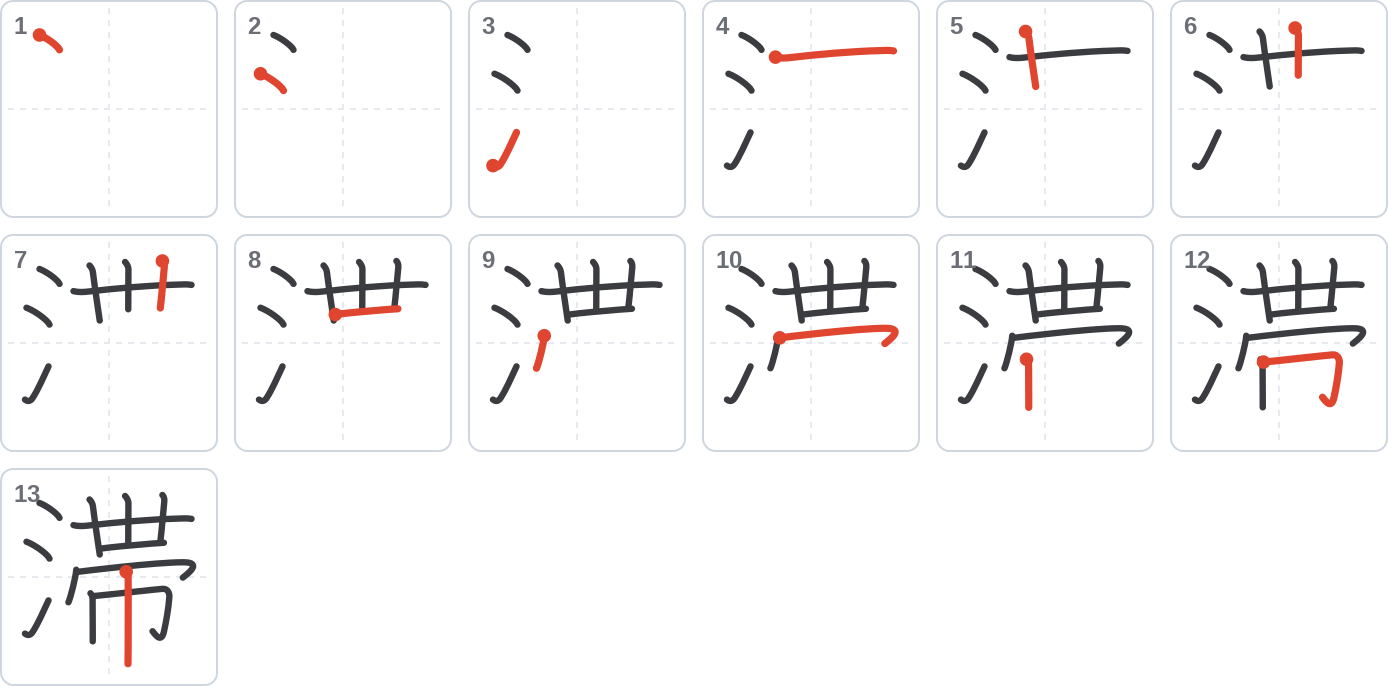
The kanji 滞 means stagnate, be delayed, overdue, arrears. It has 13 strokes.
- Meaning
- stagnate, be delayed, overdue, arrears
- Strokes
- 13
- School grade
- Secondary school
- JLPT
- N1
- Frequency
- #1,383 of 2,136 Jōyō kanji
How to write 滞: stroke order
Write 滞 in this order, starting each stroke at the red dot.
Readings of 滞
On'yomi (Chinese reading)
- タイtai
- テイtei
Kun'yomi (Japanese reading)
- とどこおるtodokooru
Practise writing 滞
Write 滞 stroke by stroke on Kanji Scholar's pad: it checks each stroke as you write and brings 滞 back for revision until you know it. Kana and the 80 Grade 1 kanji are free. 滞 is in the full course, a one-time purchase.
Common words with 滞
| Word | Reading | Meaning |
|---|---|---|
| 滞る | とどこおるtodokooru | to stagnate; to be delayed; to be left undone |
| 滞在 | たいざいtaizai | stay; sojourn |
| 渋滞 | じゅうたいjuutai | (traffic) congestion; traffic jam; gridlock |
| 停滞 | ていたいteitai | stagnation; tie-up; standstill |
| 滞納 | たいのうtainou | falling behind (with a payment); being in arrears; non-payment |
| 延滞 | えんたいentai | arrears; (being) overdue; delay (e.g. in payment) |
Where 滞 came from
滞 as it was written in China before it reached Japan, oldest first.

滯-seal.svg · Public domain
