漢KANJI SCHOLAR

欠 Lack, Gap

The kanji 欠 means lack, gap, fail. It has 4 strokes.

Meaning
lack, gap, fail
Strokes
4
School grade
Grade 4
JLPT
N3
Frequency
#981 of 2,136 Jōyō kanji

How to write 欠: stroke order

Write 欠 in this order, starting each stroke at the red dot.
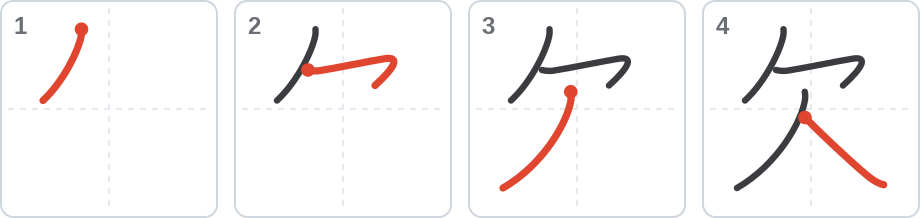
欠 stroke order: how to write the kanji 欠, 4 strokes

Readings of 欠

On'yomi (Chinese reading)

  • ケツketsu
  • ケンken

Kun'yomi (Japanese reading)

  • かけるkakeru
  • かくkaku

Practise writing 欠

Write 欠 stroke by stroke on Kanji Scholar's pad: it checks each stroke as you write and brings 欠 back for revision until you know it. Kana and the 80 Grade 1 kanji are free. 欠 is in the full course, a one-time purchase.

Practise 欠 now

Common words with 欠

WordReadingMeaning
欠くかくkakuto chip; to nick; to break
欠けるかけるkakeruto chip; to be chipped; to break (off)
欠けつketsulack; deficiency; vacancy
欠席けっせきkessekiabsence; non-attendance
欠点けってんkettenfault; defect; flaw
出欠しゅっけつshukketsuattendance; presence and absence; attendance and non-attendance

Where 欠 came from

欠 as it was written in China before it reached Japan, oldest first.

欠 in oracle bone script
Oracle bone 甲骨文c. 1200 BC
欠-oracle.svg · Public domain
欠 in great seal script
Great seal 大篆c. 800 BC
欠-bigseal.svg · Public domain
欠 in small seal script
Small seal 小篆c. 220 BC
欠-seal.svg · Public domain

欠 in handwriting and brush styles

Regular brush 楷書Yuji Syuku
Textbook hand 教科書体Klee One
Semi-cursive 行書Zhi Mang Xing
Cursive 草書Liu Jian Mao Cao

More Grade 4 kanji

Kanji that share a reading with 欠

All 202 Grade 4 kanji · All 2,136 Jōyō kanji